Character-Driven: R.J. Cutler on Anna Wintour
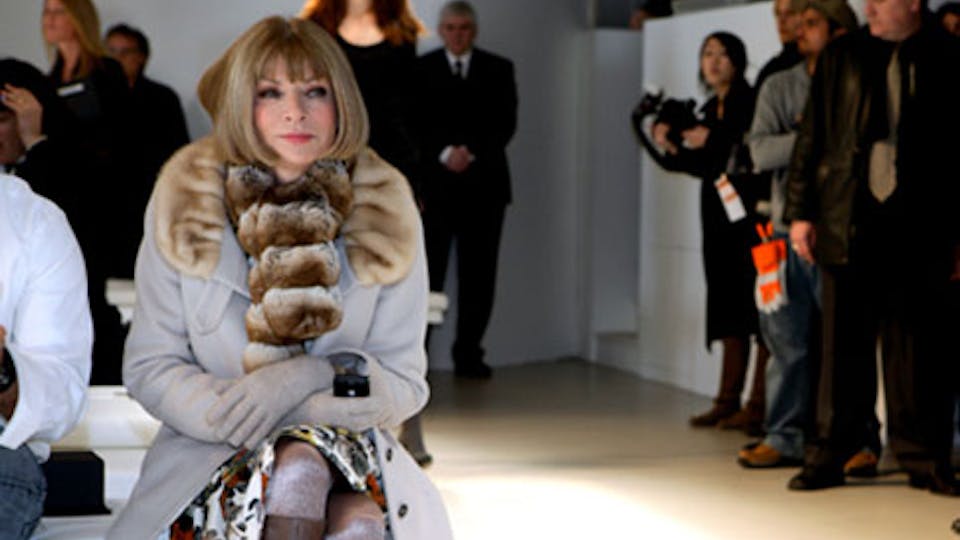
TFI Documentary FundThe September Issue, which offers an unprecedented look behind the scenes at Vogue as editor-in-chief Anna Wintour oversees the production of the titular fall edition of the influential fashion magazine.
How did you first find the main character of your film?
I didn't know Anna, except by reputation, of course. I'd read an article about her in New York magazine, and was intrigued. I sent her a letter describing what I would like to do, and we had a meeting. It became clear to me that she would be a great subject for a movie, which is a little counterintuitive, because she is famously sphinx-like and impenetrable. But while we were meeting there were a number of clues -- from the way she interacted with the other people she'd brought, this kabuki-like manner of coded language that only they understood at the time, to a thing that she said at a certain point in the conversation. I said, “If we're going to make this film, I’ll have to have final cut.” And she immediately said, “I totally understand, my father was a journalist, I'm a journalist, that's not going to be an issue.”
I was very happy about that, because there'd be no reason to even bother making the film if the filmmaker didn't have final editorial control. But what really struck me about that was the fact that she'd brought up her father. This woman who was so famously impenetrable on our very first meeting revealed to me that the way she saw herself was deeply connected to her father, and that on some level she wanted me to know that her father was an important and accomplished journalist. It seemed very clear to me that there was a lot going on under the surface. I thought, there's somebody who has a need to tell their story.
What did you expect the challenges to be in having Anna be the focus of your film?
There's only one challenge in vérité films, and that's earning the trust of your subject. It's a challenge no matter whom you're dealing with and no matter what the circumstances. It was a challenge in The War Room with James Carville and George Stephanopoulos. It was a challenge in American High with the high school seniors we filmed for over a year. It was a challenge with the young men and women in the military who we filmed for Military Diaries. It was a challenge with Anna Wintour and Grace Coddington and everybody who worked at Vogue. You must earn the trust of your subject.
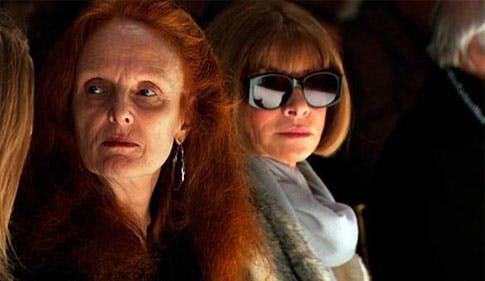
It's often the case that the person who is most resistant to you is the person who has the most to give to the film. In the case of The September Issue, that was Grace Coddington. It took me four months before Grace would allow me to film with her for a single afternoon. But my conviction from the moment I entered the halls of Vogue was that this needed to be a story about the relationship between Grace and Anna. That's what compelled me from day one of filming. I wanted Grace in there, but I had to earn her trust. And you not only have to earn the trust of your subject once, you have to earn it again and again every single day. You earn their trust by being who you say you are, by being honest, by being respectful, by believing fundamentally that the story belongs to them and not to you, by respecting that every step of the way, and by endeavoring in all ways to tell the story as truthfully as possible. And that's what we did.
I had the good fortune on The September Issue of working with the DP Bob Richman and the sound recordist Eddie O'Connor -- they're both remarkably disciplined in the vérité approach, as is our field producer Sadia Shepard. The four of us were very committed to the vérité conviction that all you have is the trust of your subjects. Once we earned it we could go to places with Anna, with Grace, with everybody in the film that we had never ourselves imagined possible, and it's a big part of why that film is both so honest and revealing.
Was there anything surprising you hadn't expected about Anna you discovered over the course of shooting, any expectations that were overturned?
We don't have expectations going in -- we only have curiosity, we only have questions. The questions are the simplest questions in the world -- Who are these people? What do they do? How do they do it? Why do they do it? Everything's a discovery. Everything you learn, you're learning for the first time. Now, of course, there's a style of documentary filmmaking where a filmmaker goes in with a point to prove and then proves it over the course of the making of the film. These essay films, often advocacy films, are very different from the work that vérité filmmakers do. We're driven by character and by story and by curiosity most of all. Everything's a discovery for us, and as a result everything's a discovery for the audience.
The September IssueVogueThe War RoomA Perfect CandidateThinAmerican High, 30 Days, Black White, Freshman Diaries, The Residents, Flip that HouseMilitary Diaries. Cutler has won an Emmy Award, a Peabody Award, and a GLAAD Award and has been nominated for an Academy Award, a Producer's Guild Award and a Spirit Award, among others. In 2009, Cutler received the Television Academy’s prestigious Honor Award for his work “creating television with a conscience,” and the Museum of Television and Radio held a five-day retrospective in celebration of his work.