Everardo González Explains His Visual Style For 'Drought'
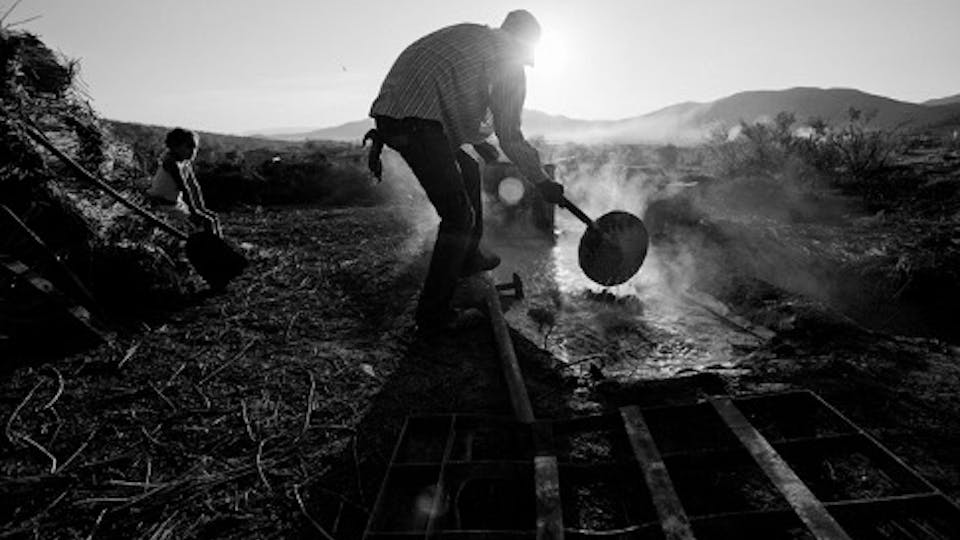
Drought, the Mexican filmmaker travels to the desert state of Coahuila to give a vertité look at the lives of a cattle-ranching community on the verge of extinction due to the horrible environment.
Drought.
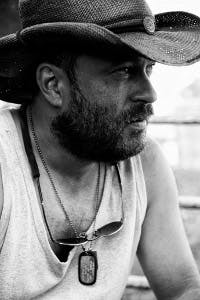
The landscape during the months of April and May in the Coahuila desert become covered in dust that the wind picks up from the dry land, while the sky, with an intense blue color, shows no clouds in sight that would forecast the chance of rain.
An elderly “water tracker” walks along the landscape with a pitchfork in hand, looking for underground water lines to find the spot where the wells can be drilled. He glances up at the sky looking for any sign of clouds, and closely observes any traces in nature that would point to the presence of water.
At the ranch, the cowboys help a stud horse mount a mare, which in turn will bear the foal that will help the family support themselves economically. The coyotes look after the cubs between the “guizaches” (shrubs), hiding them from others.
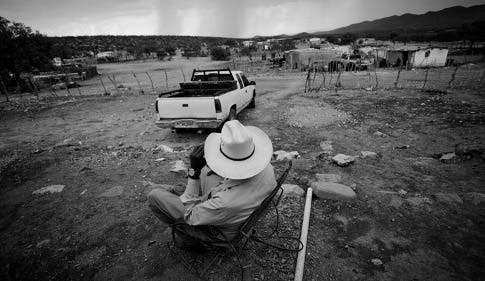
In the mountain, over a dozen men camp out. They pull from the ground the pods of the candelilla shrub, while they talk and keep themselves entertained doing the work that maintains most of their farming cooperative.
A pregnant woman works in the field, weeds the grass, washes clothes, and entertains herself listening to Northern songs inside her home. She imagines what her new baby will look like, yet worries about the world that he/she will have to live in.
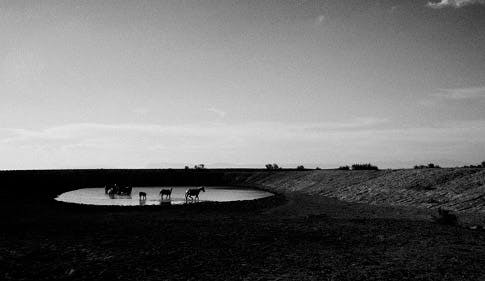
The wells are still full of water. Cows, donkeys, horses and goats approach en masse to the shore to drink the water, while the green guizache trees hover over them. A truck approaches, containing the buckets that will have to be filled. From a box inside the truck, two men bring out a bucket tied to a rope, which they throw into the well to bring water out.
This is the scene that I discovered in 2004 in the northeastern part of Mexico. A peasant man had asked me if I wanted to visit a ranch called Cuates de Australia – and I said yes.
We travelled in a truck for about 3 hours, through many paths onwards to the mountain range, until we arrived at the location. What I found was a place that was practically isolated from the world, without electricity, without roads, without any communication and without drinkable water. A place frozen in time in which its citizens didn’t care that, a short distance away, paramilitaries and drug traffickers had overtaken the town; that, to them, the Internet was more akin to something out of a science fiction film – and they weren’t much interested in events that took place in other parts of the world. They only worried about being good cowhands.
The man introduced me to the other villagers, and then I heard about their predicament for the first time: that the ranch people had to leave their homes during the drought season and wait for the rain to arrive in order to begin their routine again.
I had to wait four more years, until 2008 when I initiated a series of trips to the Cuates de Australia ranch to begin production on my film, Drought.
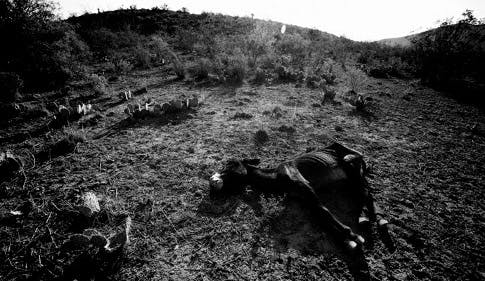
The most important factor at the onset of this project was to convey in an intimate way the short distance that exists between life and death. The desert at first glance presents itself as a beautiful and vast territory, yet that first glance does become tiresome once it focuses too much on the desert’s immensity. Regardless, in keeping with its intimacy, the desert also conveys hostility, and signals that inhabiting it will become a very difficult task.
The cinematography of Drought intends to recreate that very sensation. The aesthetic beauty of the landscape is soon engulfed by everything that feeds off from death. The coyotes that stalk the ranch during the rainy season occupy the territory as a metaphor for the end of life. The faces of its people and the ground itself dry up, and everything ages in order to open the door to the new cycle of life.
Ultimately, Drought maintains a patient rhythm – which is the only way one can wait for the arrival of the rain.
Translated by Jose Rodriguez Photos by Alberto Anaya