TAA @ 10: Paola Mendoza on Versatility
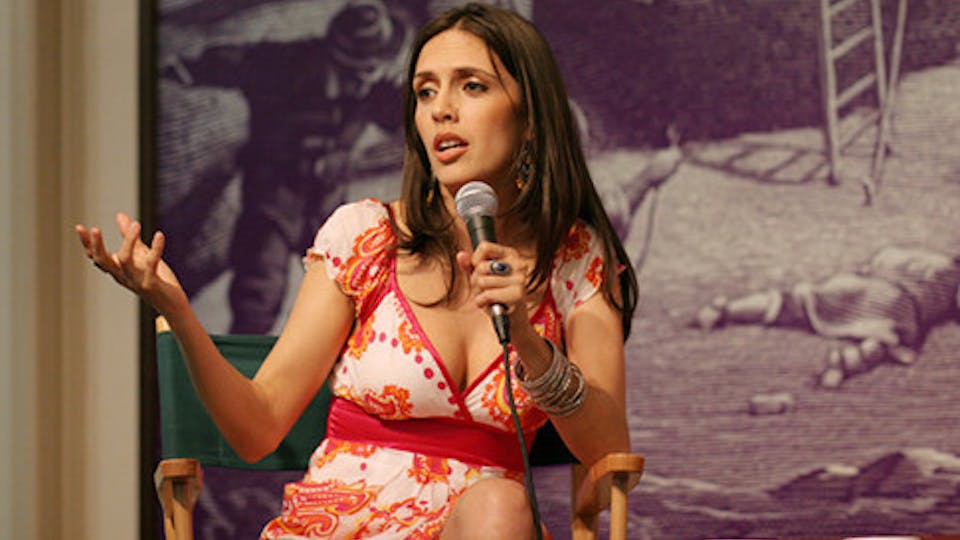
For this week’s Tribeca All Access® 10th anniversary alumni interview, we’ve asked Paola Mendoza (TAA 2009) to tell us how versatility has helped spark her film career. These days in the independent film community, it’s not all that uncommon to see filmmakers who not only write and act in their own films, but also shoot and edit them. Along with co-writing, co-directing, and starring in Entre Nos, Mendoza’s TAA grantee project, she’s also directed documentaries, acted in plays and even is finishing her first soon-to-be published novel. Read more TAA @ 10 interviews Given how many different hats you wear, has versatility been a conscious career choice of yours? Well, when I was at UCLA there was something called Theater Underground, which basically stressed that if and when you weren’t working on main stage productions, you could produce, write, direct, act. You could do whatever you needed to do in order to get your own theater productions up and running on smaller stages. And from the very beginning at UCLA, I was quite unfulfilled and unhappy with main stage productions because, as with most theater, the productions were mainly about white men and I didn’t see myself reflected in that. UCLA was the training ground for me to take my career by the horns and decide to tell the stories that were important to me. In order to tell them, I needed to fill various roles. So when I graduated, I knew I wanted to continue on that path because it was more empowering and more artistically fulfilling than just acting. You’ve shared how acting in your first feature film, On the Outs, was in many ways like going to film school. Can you share some of the valuable lessons that you learned? I think On the Outs taught me the actual, real-life lesson of how to wear many, many hats in order to get your films done. It taught me how to balance being an actor and a director because I was lucky to be in the editing room every day with the two directors of the film, and they allowed me to have a creative voice in that editing room. So, I was able to look at it not necessarily as just me on screen but more as an actress, which was crucial when we were editing Entre Nos. On the Outs also taught me the basics. I didn’t have a clue what a jump-cut was before that. What was crossing the line? What was sound mixing? It also made me believe that I could go out and make my own movie.
If I hadn’t done everything that I did in Entre Nos, along with Gloria La Morte (the film’s co-director), the film simply wouldn’t have gotten done. The reality is, independent film budgets are getting smaller and smaller, so that means you have less people that you are able to pay. Ultimately, what that translates to is having to take on multiple roles. Wearing multiple hats is the only way that I’ve been able to make the films that I want to make. Apart from acting in and directing narrative features, you’ve also worked quite extensively in the documentary world. How did you first cross over into non-fiction? It actually stemmed from On the Outs. I became very close with one of the actors on that project and decided to document their life. Throughout that year and a half I learned, through trial and error, how to make a documentary and how to capture a story as it unfolds. I would love to be able to go back and forth between documentaries and narratives, because my fiction films are based so much in reality that my documentary work feeds my narrative work and vice versa. You recently acted in Barry Jenkins’ Remigration for ITVS FUTURESTATES. How does it feel to work on projects where you are only acting? When I’m only acting it’s like a vacation because I don’t have to worry about anything else! All I have to do is act, which is tiring and difficult, but I can really focus on it, which is great. Maybe the most important lesson I learned from Remigration and Barry Jenkins was the importance of happiness on set. It may seem like it’s not a big deal, but to have the director be so full of joy and kindness, the rest of the cast and crew reflect the same energy. So, I decided I would take that attitude with me to my next directing job. I wanted to focus on being happy and smiling, because so many other times with my previous work I’ve been so overwhelmed that I’ve forgotten to enjoy it. I’ve been on a lot of different sets and I’ve seen a lot of different directors work, so I can pick and choose what I like and don’t like. You must have seen a lot of production dos and don’ts. Would you share a word of advice with our aspiring directors? I think it is incredibly important to know what you want as a director and have a clear vision. If the director doesn’t know what he or she wants, then chaos runs rampant on the set. You need someone who has a vision and knows exactly what they want from each person they work with. When the director’s vision is clear, everyone knows what they’re working towards. If you don’t have that, it’s a disaster. From a production standpoint, a disorganized set will destroy the creative process. Your vision needs to be clear before you arrive on set. Also, for me, a director that screams and yells on set is unbearable from a creative standpoint. What works is the opposite of that! A director’s positive energy is really important.
I think it’s rare in life for anything to be completely negative or completely positive. Having too much on your plate can keep you from completing any of projects you’re working on. For me, it is very important to finish everything that I start. If I write a script, I’m going to finish it and get it made. Then I can go and write a novel and finish that. If I teach, whether it’s for one month or a year, I’ll finish the job. The danger of working on a lot of projects in a lot of ways, is not finishing them. Versatility can water down your focus… but I don’t have the desire to master any one specific thing. I have the desire to tell stories. When I started my career, people always asked, “What are you? Are you a director or a writer?” At first, I told them I didn’t know. Now, I’m able to define myself simply as a storyteller. That’s it. That’s what I do. As if all this wasn’t enough, you also work in theatre and are writing a novel?! Can you share how those roles have also influenced you as a storyteller? For the past two years I’ve been working on my first novel, which is called The Ones Who Don’t Stay and it’ll be released in early 2013. This novel, like my films, came to me by accident. It just fell into my lap and I’m a firm believer that when an opportunity falls into your lap, you should take it. And so, I decided to run with it and try to write the best book possible. When I talk to my students, I tell them how so many artists are hindered by fear. They’re afraid to write their first script; they’re afraid to direct their first film and I ask these students: “what are you afraid of?” You’re afraid to write a bad script, big deal. Everyone’s written a bad script. You write a bad script and life goes on. Nothing happens to you if you write something bad. It’s worse if you don’t write it at all. When this book came to me, I was afraid, but I’ve tried to write the best book I can… and if it’s bad, it doesn’t mean that I’m a bad person. I guess that fearlessness is the most important lesson I’ve gained. It translates directly to filmmaking, but it also translated to everything I do. Be fearless with your filmmaking. Don’t make the obvious choices. That’s where the fun lies. That’s where the passion lies. What are you doing next? The next project I’m working on is a film I’m writing with Gloria La Morte and I’ll be directing on my own. It takes place in Colombia and deals with sexual violence in the context of the arms conflict in Colombia. And before we finish, I would like to take a moment to talk about TAA and TFI. The success of being a filmmaker is wrapped around building a community… and a large part of that community is through organizations like the Tribeca Film Institute®. For young filmmakers out there, you need to find these organizations and work to become a part of their family and community. TAA has helped me out, and I will always do my very best to help you in return. Thank you.