TFI Abroad: The Santiago Filmmaker Workshop
The venues were finally locked. Five documentary projects were evaluated and chosen. Then the exciting “waiting game” began, to launch the inaugural TFI Latin America Media Arts Fund Filmmaker Workshops—the first in a set of three.
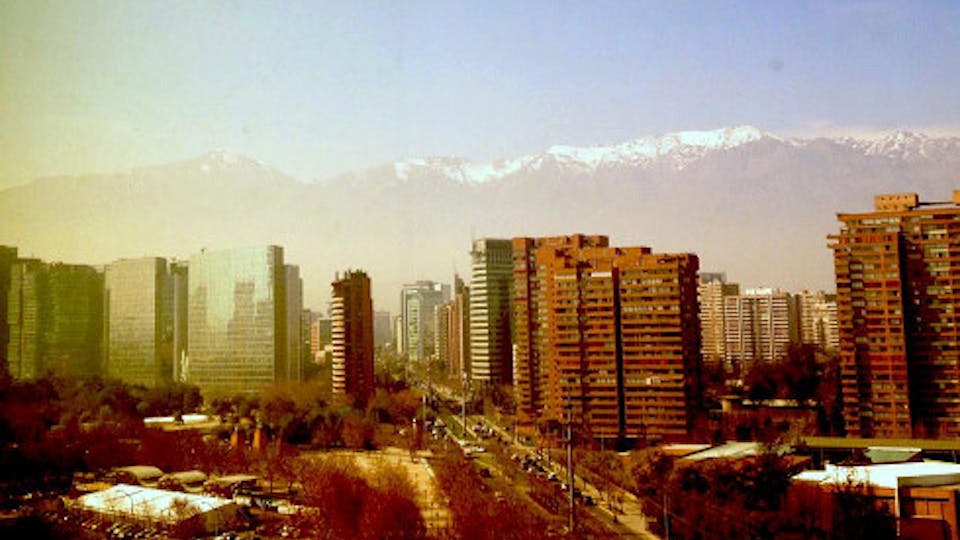
This first Filmmaker Workshop brought us to Chile, a country that we in the Doc Programming team were already familiar with, given our friendly partnership with SANFIC (Santiago Festival Internacional de Cine) last year. Their programming is quite attuned with the US film industry in both aesthetic concerns and storytelling, and their film sections incorporate documentary features and narratives together within the same competition. With such an eclectic array of content, it was only natural for us to align ourselves with them once more—this time, by slotting our Filmmaker Workshop in the project lab section of their festival: SANFIC Industria. The resources were readily available, and the collaboration between SANFIC and TFI was very much in strong footing. As a result, the workshop pre-production went smoothly – but the in-grained panic and angst was another thing entirely!
I arrived at the onset of the festival to lock down any last-minute workshop details. However, once the major logistics were confirmed, the jitters set in. Would the hired mentors’ presentation mesh well with ours? Would the curriculum and content flow nicely? Since this was our very first Latin workshop providing on-the-ground support, issues relating to a possible language barrier among the filmmakers came up in my mind. Nonetheless, we were more than ready to meet these challenges, and from the project descriptions alone, it was evident that the participants were also quite ready to grow and improve as storytellers.
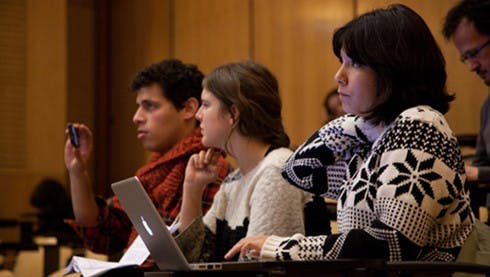
Over the two workshop days, the mentors (festival programmer Erick Gonzalez, doc filmmaker/professor Rodrigo Moreno and WNET Executive Producer Julie Anderson) curated their presentations to tap into three important aspects of project development. Erick outlined the parameters of a pitch and complemented it with his background as a programmer, while Rodrigo spoke about injecting the “personal” into non-fiction stories and investing in a tangible connection with an audience. Julie expertly capped off the conversation by providing participants with a much-needed overview on budgeting and pitching their projects to an entity like PBS. The mentors’ talks contextualized the workshop for the filmmakers, and they in turn proceeded to “cold pitch” their projects in order for us to assess each projects’ structural standing. This became a helpful exercise for the filmmakers, as it freed them to explain their stories in a casual manner while also opening up to mentors’ feedback and suggestions.
Not all of the workshop phases took place in the confines of Santiago’s Universidad Catolica. To contrast the busy pace of the mentors’ case studies, we invited the participants to attend a casual conversation with Chilean TFI/Bloomberg Fellow Maite Alberdi, where she talked about her three documentary works and showed clips of each project. With me serving as moderator, Maite delved into her creative work ethic with refreshing zeal and highlighted how she undertakes her rigorous storytelling approach. Since the focus of this talk was on her artistic process in telling stories, Maite was able to join us the following morning for a conversation on soliciting international funds and her distribution strategies. Alongside producer Paola Castillo (who produced her first documentary, El Salvavidas), Maite connected with the participants by emphasizing the importance of knowing who your audience is and trusting your producing partner to cater to the priorities of the project.
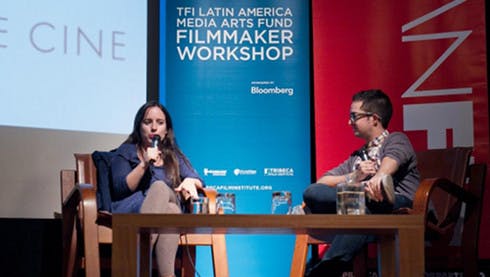
From the first day’s focus on pitch-construction, we transitioned on the second day to an analysis of how to prepare an effective treatment and grant submission. Using Maite’s application for Children (for which she received TFI support) as a case study, I led the discussion encapsulating what a detailed & strong application looks like, and how applicants can hone in on their story and maintain a clear vision. Our director of documentary programming, Ryan Harrington, and myself then discussed the funding landscape in the US and abroad, and Julie concluded the section by offering an “inside view” on WNET and all of its branches.
Lastly, the official Pitch Presentations were conducted at the end of the second day, and the mentors were joined by select pitch experts (producer Constanza Arena, SANFIC co-founder Carlos Nunez, filmmakers Alexandra Galvis and Susana Foxley) who acquainted themselves with the projects for the first time. After a hectic forty-eight hours, the participants delivered their revamped pitches and impressed the industry people in attendance. The two-hour presentation went by breezily, and it was in large part due to the filmmakers’ great improvement on their pitches and the enthusiastic participation of the mentors.
The level of progression from the filmmakers’ part from one day to the next was genuinely striking. Not only did a strong camaraderie blossom between the filmmaking teams during the evening events of the workshop, but each project successfully encapsulated in English the vision and scope of their story without having to "sacrifice" or impair the innate idiosyncrasies of their presentation skills. Ryan, the mentors and myself were heartened to see how much the participants threw themselves into the workshop curriculum and pushed themselves to reach the next step in their story formation. What was even more encouraging was that the filmmakers got as much out of it as we did, with participant Ana Maria Hurtado (director of Grandfather's Gift) informing us that the two-day lab was an invaluable experience for her as well as a turning point for her project.
Santiago was a wonderful setting to launch our Filmmaker Workshop series. Besides the succulent culinary delights that Chile offers (ceviche, sea urchins & oysters were always a treat!), it is also asserting itself quite prominently as a strong incubator for storytellers. The projects’ premises ranged from the personal and autobiographical to the quirky and unconventional, but the unifying line was clearly their goal to break through entrenched Latin stereotypes. After a weeks’ worth of “workshop-ing” and perfecting pitches, we can confidently say that they’re on their way to making that happen.
Congrats to the five projects. And thank you to Bloomberg for the generous support! Next stop for the Workshops: Sao Paulo, Brazil and Mexico City October.
See more phtos from the worshop.
The TFI Latin America Media Arts Fund Filmmaker Workshops is sponsored by Bloomberg.
[Photos by Natalia Bustamante and Jose Rodriguez]